
Vessel predictive maintenance that diagnoses, not just detects.
For every component: time to risk, ranked probable causes, and a maintenance plan continuously re-optimized around both.

Machinery failure is the leading cause of shipping incidents.
-
53%
of reported shipping incidents in 2025 were machinery damage or failure.
Source: Allianz Commercial, Safety and Shipping Review 2026 (opens in a new tab)
-
23 years
average age of the world fleet. Vessels over 20 years account for more than half of all safety incidents.
Source: Allianz Commercial, Safety and Shipping Review 2026 (opens in a new tab)
-
$650K
average main-engine damage claim. Crankshaft or bearing damage averages $1.2M per claim.
Source: The Swedish Club, Main Engine Damage (opens in a new tab)
The window is the constraint—not the data. A port call lasts hours, not days. If the cause is unknown when the vessel berths, the window closes—and the next opportunity is a voyage away.
Alarms report the failure. Predictive alerts prevent it.
An alarm says a limit has been crossed. A predictive alert says what is failing, why, and when.
Reactive alarms
- Triggered after a limit is crossed
- Say something is wrong, not what or why
- Surface at sea, far from spares and support
- Downtime and risk land on the owner
Predictive alerts
- Raised as failure probability starts to rise
- Name the failure mode, cause and horizon
- Work planned into the next port call
- Downtime avoided; schedule kept
Alarm fatigue
- 2,500 machinery alarms a day on some ships; peaks of 22,500
- < 1/3 of alarms need any action from the crew
Source: Lloyd’s Register, Alarm Management in the Maritime Industry (2024) (opens in a new tab)
Monitored equipment
Most sensor-equipped machinery onboard, across three groups of systems. We use the sensor data already onboard for a whole-vessel view of health and performance. No proprietary hardware.
-
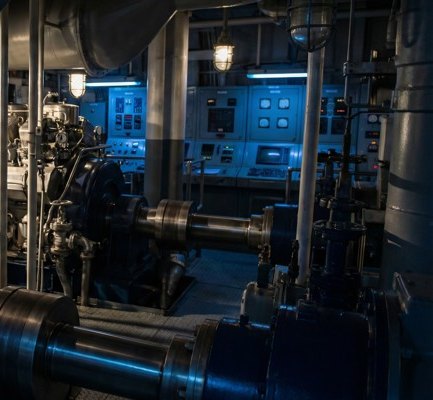
Auxiliary systems
HVAC, refrigeration, fire protection, compressed air, sea water and reverse osmosis
-
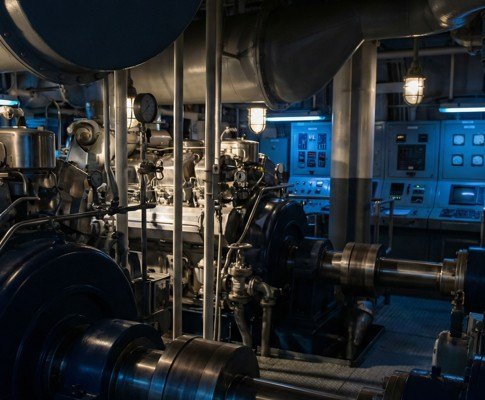
Power generation
Diesel, gas-turbine and dual-fuel generator sets and alternators
-
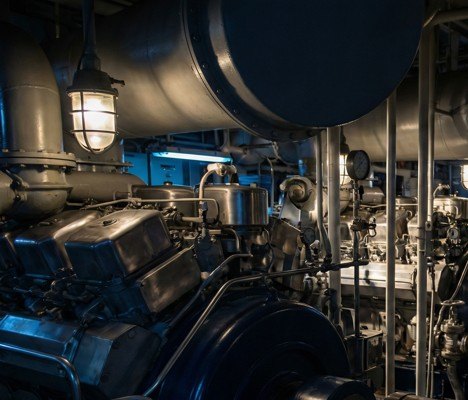
Propulsion
Main engines, turbochargers, reduction gears and shafting; lube-oil, cooling, starting and exhaust systems


It reasons over the evidence and names the failure.
From a drifting signal to a ranked cause and a job plan, before the vessel reaches port.
-
Observed
A relationship drifts that the model cannot explain away, with no single reading in alarm.
-
Reconciled
Checked against the physics of the equipment, not just its history.
-
Ranked
Competing failure modes, each with a probability and the evidence for and against it.
-
Recommended
A job plan, the parts and the timing, fitted into the next port call.
What this changes
- Inspection time collapsesThe crew starts with the most probable failure mode, not the top of a checklist.
- Optimize maintenance planningA horizon attached to a named failure mode can be planned against.
- Parts staged in advanceThe likely repairs are known before the vessel reaches port.
The fault that matters most is often the one no single alarm catches. Every conclusion traces back to the evidence that produced it.
Maintain on condition, not on the calendar.
The right work, in the right port, at the right time.
Two savings, not one: unplanned downtime avoided, and unnecessary planned maintenance eliminated.
-
Ahead of the failure window
Interventions moved ahead of the failure window.
-
More done in every port call
Related tasks consolidated into one port call, with a CBM+ plan built to get the most from every port call.
-
No unnecessary work
Healthy equipment released from unnecessary work.
SibylCor is designed to compute the Total Cost of Risk for each monitored asset: process unavailability, degraded efficiency, emergency procurement and missed operating windows.
CBM+, condition-based maintenance plus: CBM with the reliability analysis, documentation and traceability that class societies and naval programs require.
“The shipping industry is facing turbulent times, not only from geopolitical instability, but also from traditional hull and machinery risks, where we see claims costs continue to rise, as well as from decarbonization and fleet renewal challenges.”
Independent industry context. Quotation does not imply endorsement of SibylCor.
Who we’d like to talk with
Ship owners and operators
Fewer surprises at sea and more done in every port call.
Ship managers and maintainers
A ranked cause and a job plan behind every alert, so crews spend less time searching.
Shipbuilders
The right sensor package specified at design, so every hull leaves the yard ready for failure-mode diagnosis.
We’d welcome a conversation about the equipment and maintenance challenges that matter most to your fleet.
Or email info@SibylCor.com
Start with one critical asset class
One critical asset class, one narrow engagement—starting where the consequence of failure is already understood, with a low-risk path to validate SibylCor.